The Jets have spent most of the 2026 season frustrating us, but David Bailey is doing something we haven’t seen from a Jets rookie in a long time. He’s getting to the quarterback, forcing turnovers and putting up numbers that belong in the conversation with some of the best rookie pass rushers in NFL history. And while the Jets continue to struggle in the standings, Bailey is making a strong case for something this franchise hasn’t celebrated in years: an NFL Defensive Rookie of the Year award.
The interesting question isn’t just whether Bailey is having a better season than Giants rookie Arvell Reese. It’s whether the type of player voters favor for this award has changed, and whether Bailey is exactly what they’re looking for.
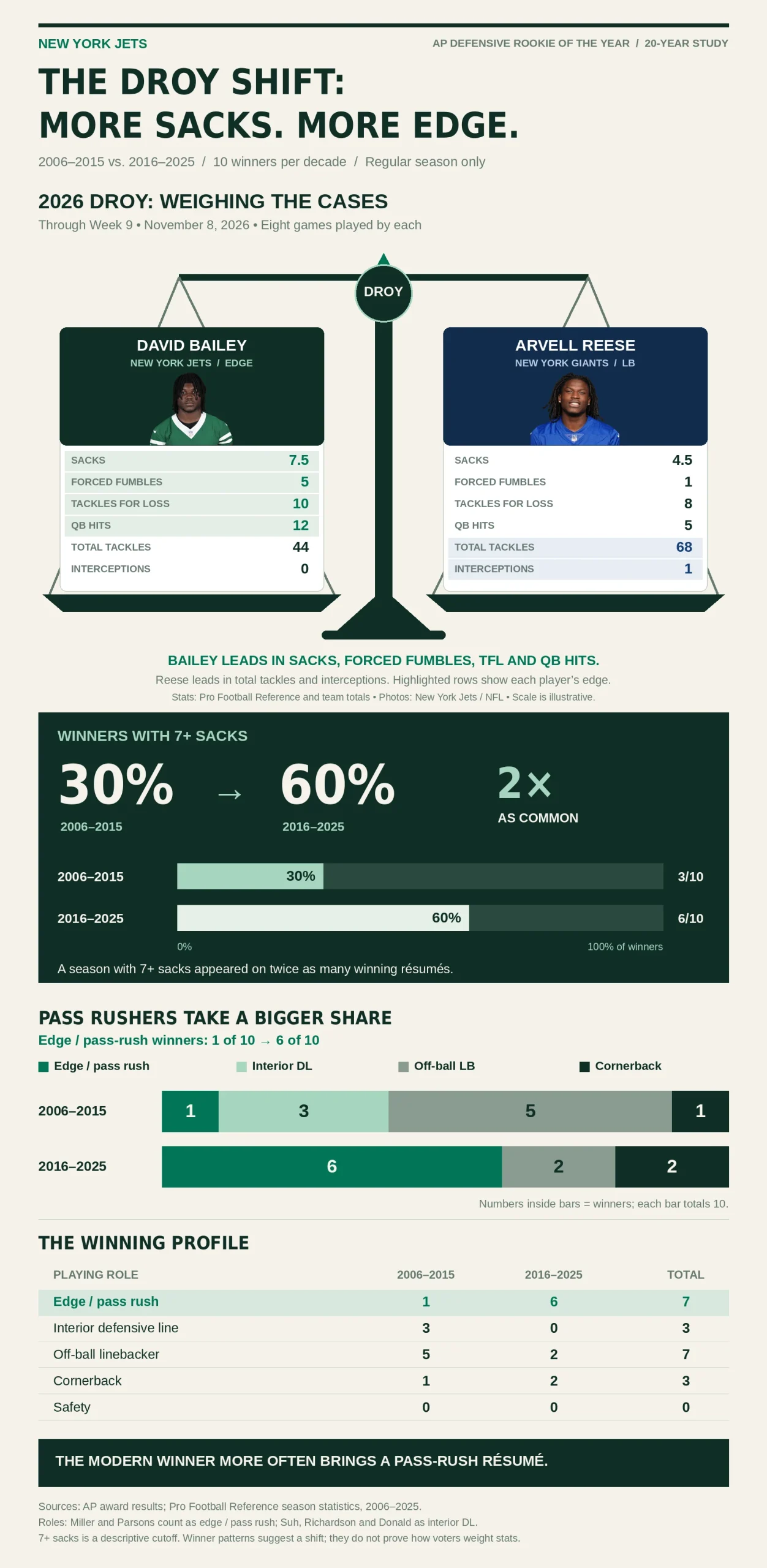
Over in the JetNation forums, Barry put together an excellent graphic comparing Bailey and Reese, but he took the analysis a step further. He examined 20 years of Defensive Rookie of the Year winners, looking at sack production and the positions that have historically won the award. The results are pretty interesting, and they suggest Bailey may have more going for him than just an impressive stat sheet.
David Bailey vs. Arvell Reese
Through eight games played, Bailey has recorded 7.5 sacks, five forced fumbles, 10 tackles for loss, 12 quarterback hits, and 44 total tackles. Reese has 4.5 sacks, one forced fumble, eight tackles for loss, five quarterback hits, 68 total tackles and one interception.
Both players are having excellent rookie seasons, and Reese deserves credit for the impact he has made with the Giants. His tackle numbers are considerably higher, which makes sense given his responsibilities at linebacker. But when you look at the statistics that measure disruption in the opposing backfield, Bailey has a clear advantage. He has three more sacks, four more forced fumbles and more than twice as many quarterback hits.
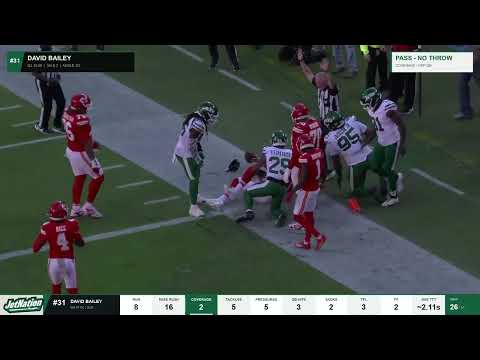
Five forced fumbles in eight games is an incredible number, especially for a rookie. Bailey has consistently demonstrated the ability to get into the backfield and make plays that can change the momentum of a game. His performance against Kansas City was another example, as he recorded two sacks and forced two fumbles against Patrick Mahomes. The Jets didn’t win the game, but Bailey continued to show why the organization felt comfortable selecting him second overall.
Has the Defensive Rookie of the Year Award Changed?
This is where Barry’s research gets particularly interesting. He compared the AP Defensive Rookie of the Year winners from 2006 through 2015 with those from 2016 through 2025, looking at both sack production and the positions played by the winners.
During the first decade, only 30% of the winners recorded at least seven sacks. Over the following decade, that number jumped to 60%. In other words, a season with at least seven sacks appeared on twice as many winning resumes during the more recent period.
The positional breakdown tells a similar story. From 2006 through 2015, only one of the ten winners was classified as an edge or pass-rush player. Five were off-ball linebackers, three were interior defensive linemen and one was a cornerback. From 2016 through 2025, six of the ten winners were edge rushers, with two linebackers and two cornerbacks accounting for the remaining awards.
That’s a significant shift in the types of players receiving recognition. It doesn’t necessarily mean voters are consciously prioritizing sacks, and a sample of 20 winners isn’t enough to establish a definitive trend in voting behavior. But it does suggest that players who can consistently pressure the quarterback have become increasingly prominent in the Defensive Rookie of the Year conversation.
For Bailey, that’s encouraging because his biggest strengths are exactly what those recent winners have brought to the table.
Bailey Is Putting Up Historic Numbers
Bailey’s production isn’t just impressive when compared with Reese. His start has also put him in some interesting historical company. According to NFL statistical notes, his 7.5 sacks through eight career games are tied for the fifth-most since sacks became an official statistic in 1982. He is also the first player since 2000 to record at least five forced fumbles in his first eight games.
With another 1.5 sacks in his ninth game, Bailey would join Julius Peppers, Hugh Douglas and Santana Dotson as the only rookies since 1982 to record at least nine sacks in their first nine career games. Jets fans will remember Douglas, who recorded 10 sacks during his rookie season with the team in 1995.
It’s still early in Bailey’s career, and there will undoubtedly be adjustments as opposing offenses spend more time preparing for him. But the fact that we’re already discussing his production alongside some of the better rookie pass rushers in NFL history tells you how impressive his start has been.
The Jets May Have Gotten This One Right
There has been plenty of debate about whether the Jets should have selected Bailey or Reese, and I don’t expect that conversation to disappear anytime soon. Both players were drafted at the top of the first round, they play in the same market, and their careers will probably be compared for years. Reese looks like an excellent young player, but I have a hard time criticizing the Jets for selecting Bailey based on what we’ve seen so far.
Finding a legitimate edge rusher is difficult enough. Finding one who can immediately make this kind of impact is even harder, and Bailey has already demonstrated the ability to disrupt opposing offenses without needing several seasons to develop. For an organization that has made more than its share of questionable personnel decisions, Bailey looks like someone the Jets can build around.
One thing I’d like to see is the coaching staff continue to maximize his opportunities to rush the passer. There has been discussion about how frequently Bailey is asked to drop into coverage, and while I understand that defensive schemes require versatility, I would prefer to see a player producing this much pressure going after the quarterback as often as possible. That is one of the (many) changes we will see next year with a new regime.
Can David Bailey Win Defensive Rookie of the Year?
I think he has a legitimate chance, although Reese is certainly going to be a factor in the race. There is still plenty of football left to play, and both players will have opportunities to strengthen their cases over the second half of the season. What Barry’s graphic illustrates is that Bailey isn’t just having an excellent rookie season. He is putting together the kind of pass-rushing resume that has become increasingly common among Defensive Rookie of the Year winners. If he continues producing sacks, forcing fumbles and disrupting quarterbacks at this pace, it will be difficult to overlook him when the votes are cast.
The Jets haven’t given their fans much to celebrate this season, but watching Bailey develop has been one of the few legitimate bright spots. Regardless of what happens with the award, the Jets appear to have found an impact defensive player who could be a cornerstone of this defense for years to come.
Thanks to Barry for putting together the graphic and doing the research. It’s a great example of the football discussions that make the JetNation community worth visiting.